Paper just out, by Rebucci, Toraman, Valente, and Capirone:
Uncovered interest parity (UIP) tends to hold at long horizons for advanced-economy currencies. Whether it holds in emerging markets remains a more open question. We show it does not, and that sovereign credit risk can explain the failure. Using monthly zero-coupon local-currency yield curves for all emerging market currencies for which they are available from 2000 to 2025, we find that the slope of long-horizon UIP regressions is well below one at the five-year maturity for emerging market currencies, while unity cannot be rejected for G10 currencies. However, when we augment these regressions with sovereign CDS spreads, this slope rises to values statistically indistinguishable from one for floating emerging market currencies. The correction works best for currencies whose credit risk is most variable. A no-arbitrage asset pricing framework guides the specification of the regressions and the interpretation of the results.
A key table:
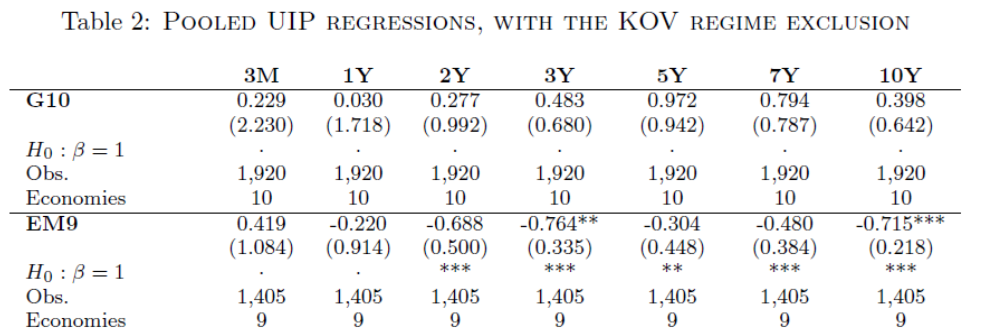
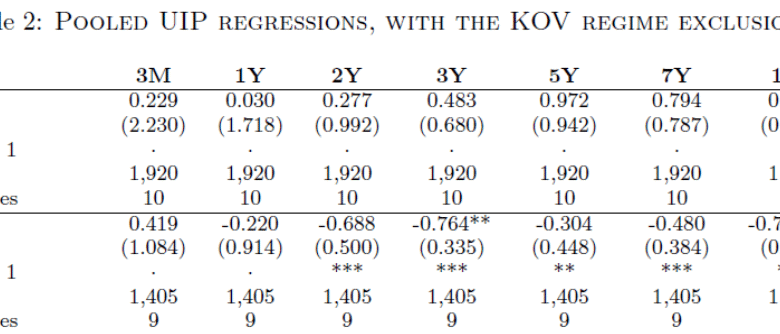
Note: The table reports panel estimation results of Equation (1) for each group, at different maturities, estimated on a common sample across maturities from 2000m1 to 2015m12 (the last possible year-month observation allowing for a 10y forward exchange rate difference to be computed with our data sample ending in 2025m12)….All regressions include currency fixed effects. The standard errors are Driscoll and Kraay (1998) heteroskedasticity and autocorrelation-consistent (HAC) with Lazarus, Lewis, Stock, and Watson (2018) bandwidth and Vogelsang (2012) fixed-b pvalues. Stars on the coefficient test H0 : β = 0; the third row of each block tests H0 : β = 1. A dot means not rejected. “Obs.” is the number of economy-month observations, and ”economies” is the number of economies in the regression. *, **, *** indicate significance at the 10%, 5% and 1% level, respectively.
Table 3 results are consistent with default risk importance (where the real exchange rate is highly persistent).
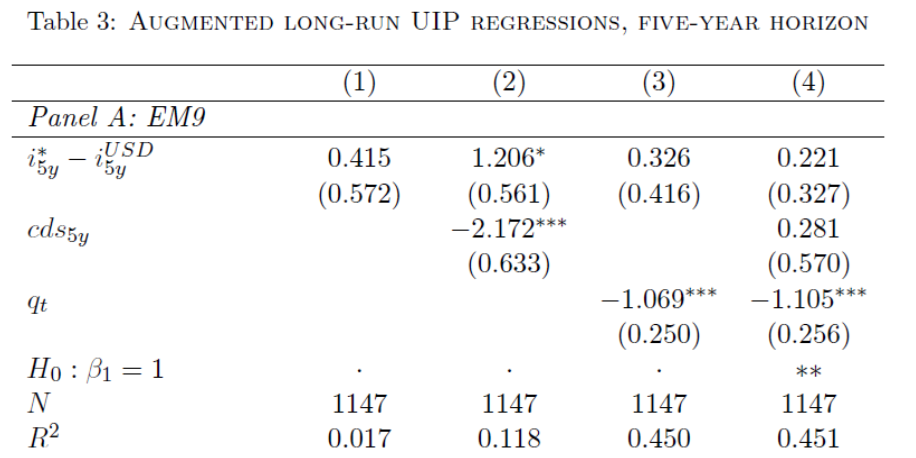
Note: The table reports the estimation results for Equation (3). The dependent variable is the cumulative five-year log change in the bilateral nominal exchange rate against the U.S. dollar, ln(St+60) − ln(St). The interest differential is the cumulative five-year continuously compounded differential, 5[ln(1 + i∗5y) − ln(1 + iUSD 5y )]. The CDS spread is cds5y = 5 ln(1 + CDS5y/10,000). The bilateral real exchange rate is qt = ln(St) + ln(CPIUSD t ) − ln(CPIt); a rise in qt denotes a real depreciation against the U.S. dollar. All four specifications are estimated on the CDS-available sample from 2000m1 to 2015m12; a common sample is only imposed within each panel and is allowed to vary across panels. … All regressions include currency fixed effects. Inference uses Driscoll–Kraay HAC standard errors, Lazarus et al. (2018) bandwidth, and fixed-b critical values. Stars denote significance against zero; in the unit-slope H0 rows, stars denote rejection and · denotes non-rejection. Significance levels are 10%, 5%, and 1%.
I find these results quite interesting, as they verify (to some degree) findings I obtained for G3 currencies, over the 1983-2022 period, as described here.
Source link